Annual Report 2025 | Bridging the Divide on Firearm Policy
The Bridging the Divide on Firearm Policy Project is an initiative, supported by Tufts CTSI (non-federal funds), that brought together a nationally representative panel of stakeholders from both the gun rights and gun violence prevention communities. Over the course of a year, participants engaged in a series of professionally mediated deliberations with the goal of creating a firearm policy proposal capable of garnering broad support across states.
 The project was motivated by a 2022 survey conducted by Michael Siegel, MD, MPH, which identified substantial common ground between gun owners and non-gun owners on a wide range of firearm policies [1]. Despite this overlap, political discourse and media narratives often portray these two groups as diametrically opposed. Gun rights and gun violence prevention stakeholders alike have fallen victim to a perception gap, in which the perceived level of disagreement between these two groups is widely overestimated.
In fact, recent research suggests that political polarization is driven less by policy differences and more by social identity conflict. In his book, Why We’re Polarized, Ezra Klein explains: “There’s only a weak relationship between how much a person identifies as a conservative or liberal and how conservative or liberal their views actually are— to be exact, in both cases it’s about a .25 correlation” (pp.73-74). Klein also cites Geoffrey Cohen, whose research shows that individuals are often willing to adopt policy positions endorsed by their political party even when those positions contradict their prior beliefs [2].
Building on these findings, Dr. Siegel hypothesized that polarization around firearm policy is rooted more in identity than in substantive disagreements. To test this, a nationally representative panel of 23 leaders from both gun violence prevention and gun rights sectors convened for a structured, yearlong process aimed at developing an actionable roadmap for all states to reduce gun violence.
This approach draws on research on “minipublics”— forums designed to engage diverse participants in merit-based discussions—which support the assertion that the best way to break through identity-driven polarization is to refocus discussions on ideas [3]. A cornerstone of the Bridging the Divide Project was identifying shared principles to guide firearm policy, an element often missing from public debate. Another prerequisite for the project’s success was reframing firearm policy from a zero-sum game, in which increased public safety is seen as coming at the expense of freedom and convenience for gun owners, to a positive-sum game, in which all stakeholders benefit. Without clear benefits to gun owners, there is no logical incentive for them to even come to the negotiating table.
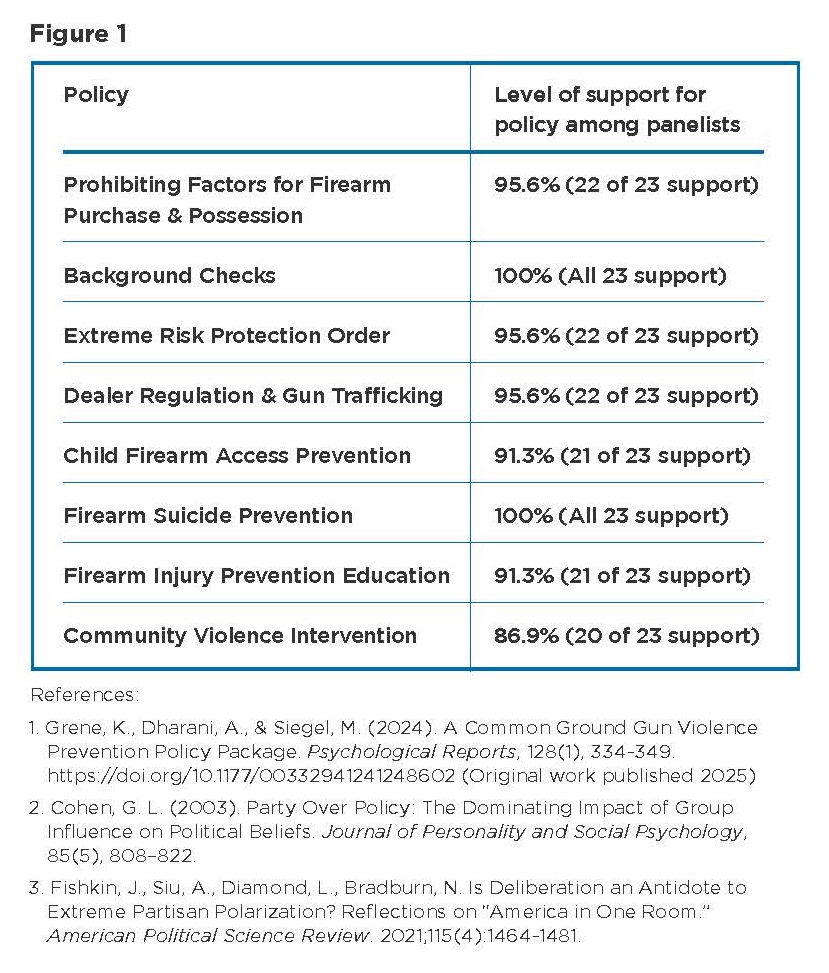
During a February press conference attended by approximately 50 members of the media and stakeholders, Dr. Siegel revealed that the project panel had reached consensus on a package of eight state-level firearm policies. These policies aim to protect public safety while safeguarding the rights of gun owners, and all received high levels of approval within the panel (Figure 1). Both the policy and press conference recording are publicly available at BridgeTheDivideNow.org.
The next stage of this project will focus on disseminating the policy package to key stakeholders with the aim of advancing adoption in state legislatures nationwide.